6 things pediatricians want you to know about vaccines

Rawpixel.com // Shutterstock
Back in the early 1900s, about one in five children died before entering kindergarten. The most common reason: infectious disease. Today, just one in 27 dies so young, most often because of an accident. Those saved lives are largely thanks to vaccines, which introduce weakened or killed viruses or bacteria into the body to trigger the body’s natural defenses and immune responses.
Over the years, vaccines have prevented millions of hospitalizations and childhood deaths. As the number of cases of serious, vaccine-preventable diseases, like measles, starts creeping back up, it’s more important than ever for parents to have evidence-based, up-to-date information about childhood vaccinations and the vaccine schedule.
Sticking to a vaccine schedule that’s been approved by top pediatric experts as both effective and safe is key to protecting your child. Pediatric infectious disease specialist Mundeep Kaur Kainth, DO, MPH, told Northwell Health what she wants parents to know.
1. Vaccines work
“Vaccines are extremely effective at preventing diseases. It’s why we haven’t seen some diseases — smallpox and German measles, for example — for generations,” says Dr. Kainth. “The fact that we’re seeing some of these preventable diseases coming back has nothing to do with how well vaccines work. It’s because fewer people are getting their children vaccinated.” In a way, vaccines are victims of their own success, says Dr. Kainth. “One of the things parents say to me is, ‘I’ve never seen polio or measles before.’ We have a whole generation of parents who have not seen these illnesses as their parents did, which is wonderful — but also means they don’t feel the same urgency to vaccinate.”
2. Vaccines are safe
Parents sometimes cite possible side effects as a reason to opt against vaccination, Dr. Kainth says. But the most common side effects, such as soreness or swelling at the injection site, fever or fatigue, are temporary inconveniences that recede on their own or with small doses of Tylenol. “I’m far more concerned with the disease I’m preventing, which generally can have very serious outcomes, such as hospitalization or death,” she says.
The truth about vaccines and autism
As for concerns about autism: A number of very large, well-designed studies have searched for signs of a link with vaccines and have failed to uncover anything worrisome. Allergic reactions to vaccinations are also exceedingly rare. The worst reaction she sees? Fainting from anxiety. “Honestly, way more patients are anxious about getting shots than are allergic to vaccines,” she says.
3. Following a vaccine schedule is critical
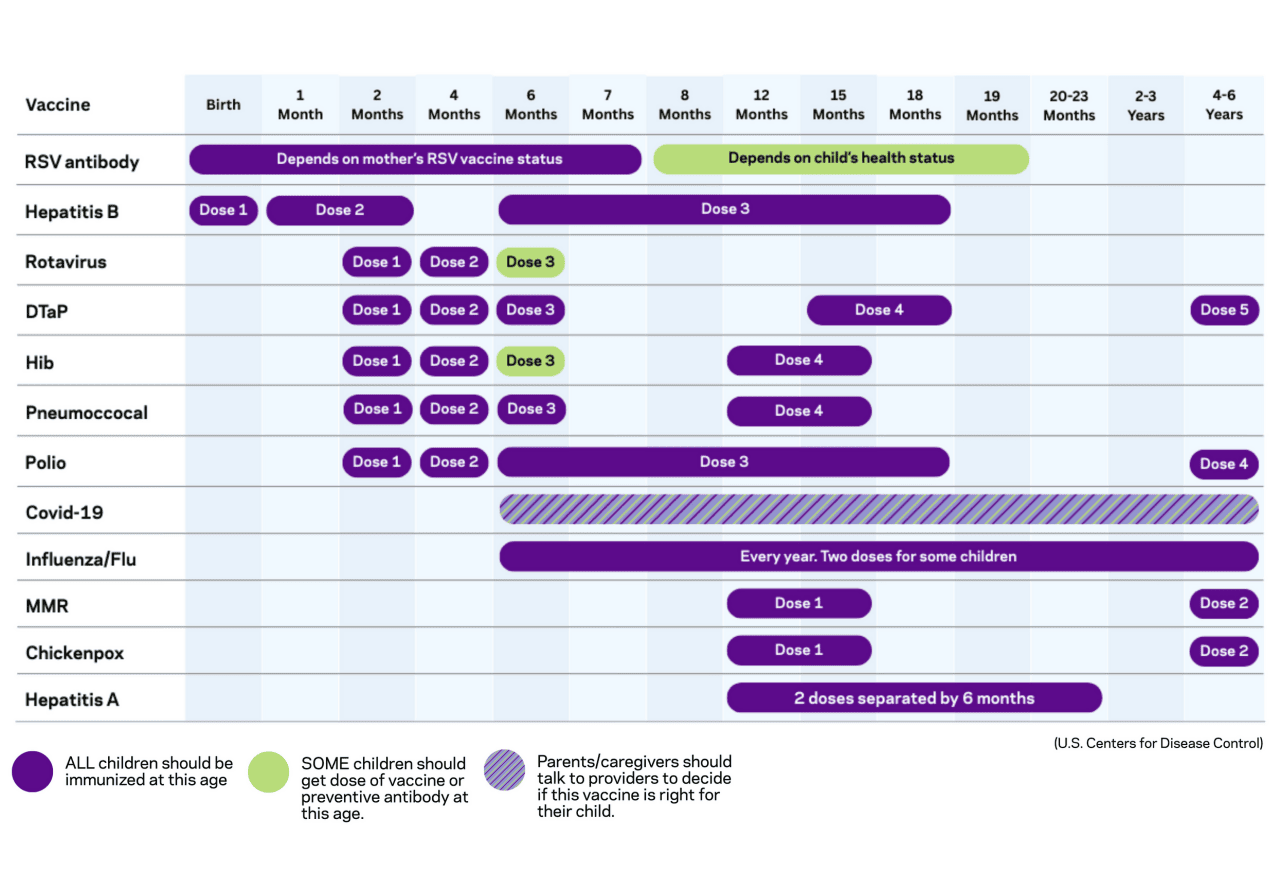
Just as vaccines themselves are carefully researched and tested, so is the timing of vaccine delivery, says Dr. Kainth. She points to the decades of research and detailed studies that have led to a safe and reliable vaccine schedule for parents, including the age at which the vaccinations should be given, how many doses are needed, and how long to wait between doses.
Consider pneumococcal meningitis, a deadly bacterial disease that swells the membranes of the brain and spinal cord. “Studies have shown that children are most likely to acquire and spread the bacteria at around 18 months of age, when they tend to be grouped together in daycare or exposed to other children,” says Dr. Kainth. That’s why youngsters should get all four doses by 15 months of age, she says. “If you wait longer, the risk of developing disease or complications goes up.”
A vaccine schedule for parents
Northwell Health, U.S. Centers for Disease Control
4. The danger of missing vaccinations: The lesson from measles
Measles was declared eliminated in the U.S. in 2000, though the virus still existed globally. That was an important feat for two reasons. First: Measles is dangerous. It can cause serious complications, including pneumonia, encephalitis (swelling of the brain) and even death. Second: Measles is highly contagious, says Dr. Kainth. The combination makes herd immunity vital.
What is herd immunity?
Herd immunity is achieved when enough people are immune to a disease — because they’re vaccinated or because they were previously exposed — that it’s hard for infection to spread. Herd immunity can protect people who aren’t able to get the vaccine, due to cancer or another immunocompromising condition.
Picture a herd of immune people surrounding every individual who’s unable to get a vaccine. But declining vaccination rates have led to measles outbreaks in the U.S. — over 1,000 cases in 2025 by May. Those numbers have also whittled away at herd immunity, so if someone isn’t able to be vaccinated, they’re now at higher risk of getting the disease. After two decades in practice, Dr. Kainth recently made her first measles diagnosis, in a child from Suffolk County, New York.
5. New vaccines continue to save lives
Most people are familiar with the Covid-19 vaccine, which was created quickly in response to the pandemic that swept the world. “Because of the Covid-19 vaccine, we avoided a million additional deaths,” Dr. Kainth says. But new childhood vaccines are being developed, too.
RSV vaccine: A powerful defense for infants
“The most recent exciting news in vaccines came in 2023, when two new methods were approved to help babies avoid respiratory syncytial virus, or RSV,” Dr. Kainth says. RSV typically feels no worse than a bad cold for adults, but it’s the leading cause of hospitalization in kids under 2.
One avenue of protection is available during pregnancy: Women can get a vaccine called bivalent RSVpreF (Abrysvo) late in the third trimester. Abrysvo spurs production of antibodies that pass through the placenta and protect newborns for their first six months, when they’re most vulnerable. The second new option is a shot for babies up to 8 months of age. Called nirsevimab (Beyfortus), it’s technically not a vaccine, but a long-acting monoclonal antibody that targets the RSV virus. It’s given in the fall and offers protection during the critical first years of life.
A record of success
The American Academy of Pediatrics gathered data to estimate the positive impact of vaccines on children born in the U.S. between 1994 and 2023.
Vaccines have prevented:
- 1.13 million deaths
- 508 million illnesses
- 32 million hospitalizations
- 1.8 million cases of polio
- 752,800 diphtheria deaths
- 100 million cases of measles (and 13.2 million hospitalizations for measles)
6. Talk to your pediatrician about vaccines
Pediatricians are happy to answer parents’ questions about childhood vaccinations, says Dr. Kainth. “I spend a lot of time debunking myths,” she says. There is a lot of vaccine-related misinformation passed around from parent to parent, she says, particularly on social media. “When parents say things like, ‘Oh, my kid won’t get sick from measles or chicken pox,’ for example, it gives me a chance to remind them why a particular vaccine was created in the first place, why it’s safe and why we don’t have a lot of concerns about vaccine risks to children.”
Dr. Kainth cites the false claim linking autism to the MMR (measles, mumps and rubella) vaccine as something she continues to address with parents, even though the fraudulent study the claim was based on was officially retracted in 2010 and its author was barred from practicing medicine. “Please talk to your pediatrician about vaccines — how they work and about their safety,” she says. “We are here to provide you with the latest medical information that will help you keep your child well.”
This story was produced by Northwell Health and reviewed and distributed by Stacker.


