The 'Sick Building' Syndrome: Indoor air quality services and employee productivity


Friends Stock // Shutterstock
While remote work might have been in the spotlight in recent years, many businesses are now actively encouraging, or even mandating, a return-to-work strategy that brings employees back into the office.
In theory, this is designed to improve productivity and strengthen team bonds, which is difficult or impossible when everyone is based in different locations.
However, one overlooked impact of return-to-work policies is that they do not account for air quality issues in commercial buildings, The Way Commercial Cleaning notes.
This trend, dubbed sick building syndrome, can be detrimental to employees’ effectiveness once they get back into the swing of sharing office space. Once understood, it explains why indoor air quality services are increasingly in demand. Here’s an overview of the data behind it, and the options available to organizations that want to amplify productivity in a return to work scenario.
The Way Commercial Cleaning
What is Sick Building Syndrome?
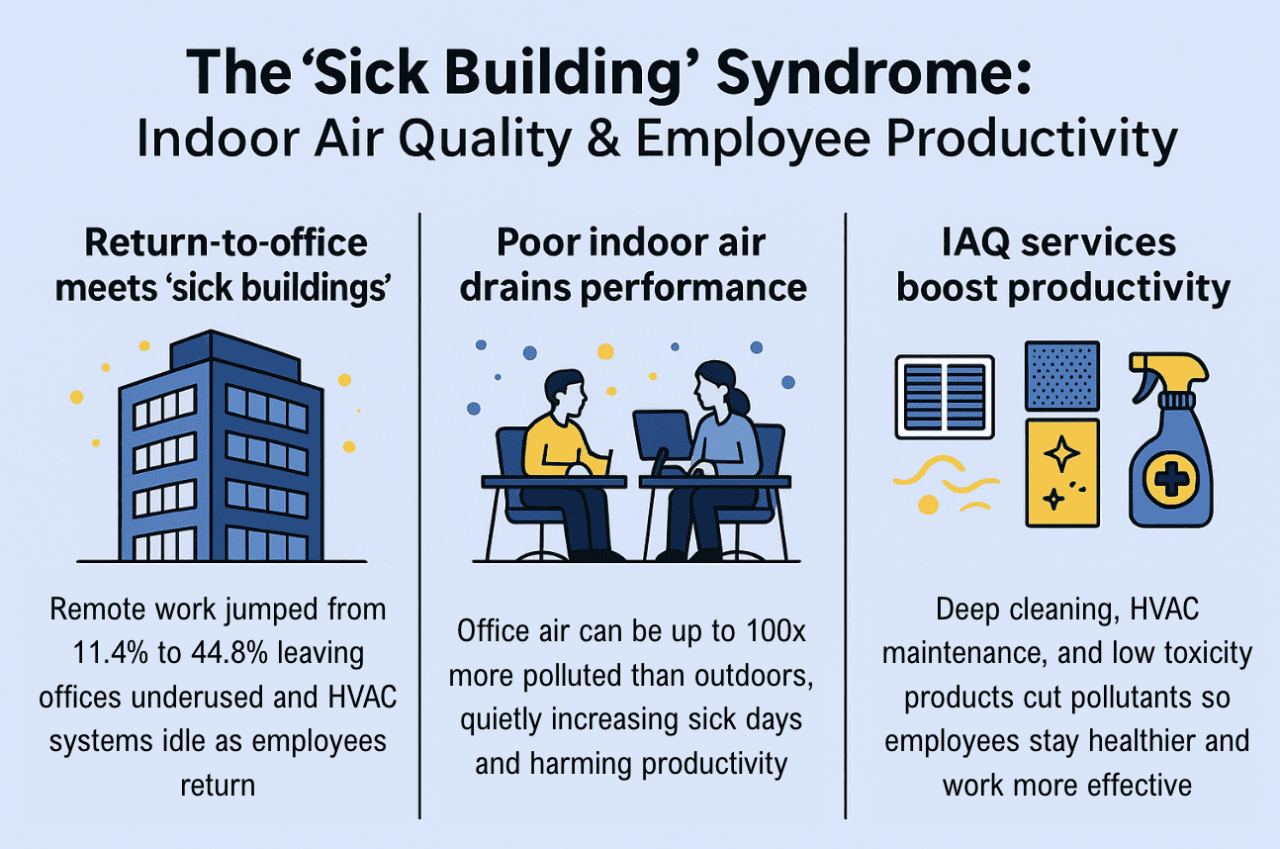
The explosion of remote working in the wake of the 2020 pandemic was impressive. U.S. Bureau of Labor Statistics data shows that in 2019, 11.4% of workers in the information sector were based primarily at home. In 2021, this rose to 44.8%.
However, by 2022, there was a sharp decline in remote working, if not a complete reversal. Since then, it has continued to drop at a slow and steady rate. Return-to-work policies have precipitated this, although not without unforeseen sticking points.
Sick building syndrome is one such obstacle. It reflects the fact that while office buildings went unoccupied or under-occupied, they effectively sat stagnant. HVAC systems were not used as intended, and internal air quality declined significantly.
It’s the equivalent of leaving a vehicle to sit on a driveway for a year and expecting it to fire up the first time. In reality, flat tires, a dead battery, and the potential for rodent infestation in vital mechanical components are all more likely.
Simply turning on HVAC equipment and expecting it to resolve sick building syndrome is not sufficient. Instead, intervention from specialists becomes necessary to avoid the worst effects of deteriorated office air quality.
Considering EPA Guidance
The Environmental Protection Agency (EPA) offers extensive guidance on indoor air quality for office buildings, as well as commercial residences. From a business perspective, the importance of indoor air quality services lies in their impact on productivity.
This is a long-established relationship, with an EPA report dating back to 1989 pinpointing the fact that when indoor air quality improves, there’s an associated uptick in employee productivity and a decrease in the number of sick days taken. The annual economic and healthcare costs of poor indoor air quality thus rank in the tens of billions of dollars.
The EPA cites several primary categories of pollutants relevant to office building operators, including biological contaminants such as bacteria and viruses, chemical pollutants from office equipment emissions, and particles from internal materials and external sources. Since most offices are in urban areas, exposure to pollutants is naturally higher. Even so, internal pollutant levels can be as much as 100 times greater than those recorded in outdoor areas, even in busy cities.
Put simply, the risks are real, and businesses that have lain dormant or been used by only a fraction of their potential capacity for extended periods may present a productivity and health hazard when return-to-work policies are enacted.
How Indoor Air Quality Services Help
In response to the needs of businesses, there are several indoor air quality services available so that office spaces do not suffer from a buildup of pollutants that threaten to harm productivity.
First and foremost, regular cleaning of all internal spaces to remove the build-up of biological, chemical, and particulate pollutants forms the core of this strategic service deployment. Neutralizing and removing contaminants from surfaces prevents them from being recirculated in the air.
Additionally, organizations must consider proper deep cleaning and maintenance of HVAC systems themselves, as these can become conduits for pollutants if not properly addressed.
The choice of equipment and products used within an office can also be considered as part of broader efforts to improve internal air quality. For instance, switching from harsher chemical cleaners to products that pose less of a risk to humans if inhaled is a wise move.
These are all aspects that expert indoor air quality services can advise on, so businesses do not need to combat this complex concern alone.
The End Result for Employee Productivity
Addressing air quality issues in office buildings has the ability to minimize both acute and long-term health issues associated with exposure to an excess of pollutants. When employees are healthier, they are happier, and in turn, more productive.
This is one variable in the productivity spectrum over which businesses have direct control, so it makes sense for them to prioritize the simple processes required to bring it up to scratch.
Other factors, such as flexible working, employee perks, and proactive team building, can have a measurable impact on employee morale and productivity. However, businesses that go above and beyond by addressing factors such as air quality are more likely to flourish as the return-to-work push gathers momentum.
This story was produced by The Way Commercial Cleaning and reviewed and distributed by Stacker.


