A first look at November hiring shows the private sector lost 32,000 jobs
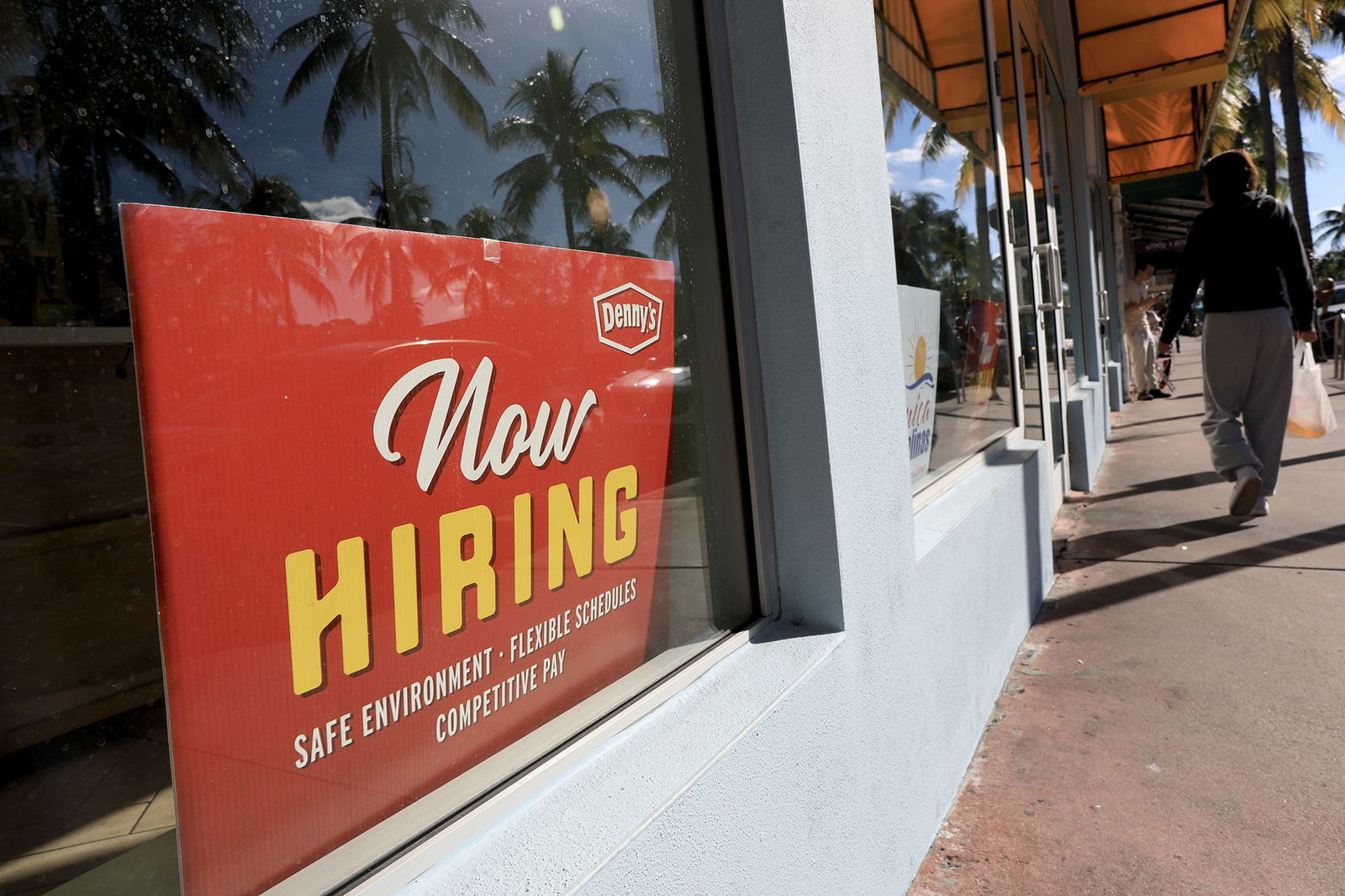
A 'Now Hiring' sign sits in the window of a Denny's restaurant on November 19 in Miami.

By Alicia Wallace, CNN
(CNN) — Small businesses are starting to crack amid a weakening economy, rising costs and fickle consumers; and they drove job losses in the US private sector in November, payroll giant ADP reported Wednesday.
ADP’s latest monthly look at private-sector employment showed that about 32,000 jobs were lost last month, marking a drop-off from the upwardly revised 47,000 jobs gained in October.
ADP’s reports have gained in prominence in recent weeks as the longest shutdown in US history stifled statistical agencies’ abilities to collect, analyze and release economic data.
The November jobs report, originally slated for release on Friday, is delayed until December 16. It also will include partial data from October, a month where a full jobs report was nixed.
As such, Wednesday ADP data is likely the next-best estimate on the labor market Federal Reserve officials will get before their policymaking meeting next week.
Still, while ADP’s tabulations don’t often correlate with the official jobs numbers, they’re looked to as an indicator of hiring and wage growth activity.
And in recent months, that trajectory hasn’t been great.
Private employers have shed jobs in four of the past six months, ADP data shows. The net loss of 32,000 reported for November is the largest monthly drop in two and a half years.
“The (ADP) report shows the job market is losing more momentum at year-end and skews risks toward modestly higher unemployment early next year,” Oren Klachkin, Nationwide’s financial markets economist, wrote in a note Wednesday. “There’s a high level of disagreement among Fed policymakers right now, but we maintain our call the doves will prevail over the hawks and the FOMC to vote for another [quarter-point] interest rate reduction at next week’s meeting.”
Canaries in the coal mines
The estimated job losses reported for November were overwhelmingly at small establishments (classified as having between one and 49 employees), which shed an estimated 120,000 jobs last month. Medium and large businesses added 51,000 jobs and 39,000 jobs, respectively.
“When you look historically, the labor market is not weak, but it is weakening — and the first to crack are small establishments,” Nela Richardson, ADP’s chief economist, said Wednesday in a call with reporters. “I see them as a canary in the coal mine. Things could shift, but small firms are the leading indicator.”
It’s possible that the steep losses at small businesses could be tied to spillover effects from the US government shutdown, which lasted from October 1 to November 12, she said.
However, the estimated labor force cutbacks are likely more a reflection of small businesses trying to weather an uncertain economic environment and an increasingly cautious consumer, she said.
“You can see that there are a lot of different angles of concern for the smallest firms: It’s about supply, it’s about high price levels,” she said Wednesday. “Even if you think that inflation is declining or moderate or any tariff impact is transitory, if you look at cumulative price increases over the last five years, it’s up around 25%.”
In uncertain times, businesses stay lean
And when small businesses don’t have the wiggle room to navigate higher prices – notably the ability to absorb cost increases from frequently shifting tariffs – they often shift their hiring patterns to help offset rising costs, she added.
Businesses are likely staying lean – delaying hiring, not replacing workers – versus making outright layoffs, so that they can weather an uncertain economic environment, she said.
“And all of that is adding up to job losses on a national level,” she said.
That low-hire, low-fire activity has been heavily supported by other economic data, specifically claims for unemployment benefits. First-time claims have remained fairly stable while continuing claims (those filed by people who have received a week or more in jobless benefits) have been butting up against four-year highs.
By industry, the losses were more broad-based, with some of the deeper drops in industries such as professional and business services, information and manufacturing.
Economists were expecting that 40,000 jobs would be added, according to FactSet.
ADP’s estimates are drawn from anonymized and aggregated payroll data from its clients.
The-CNN-Wire
™ & © 2025 Cable News Network, Inc., a Warner Bros. Discovery Company. All rights reserved.


